

.png)
Back in 2024 at the IN/Clojure Conference, FORMCEPT co-founder Anuj Kumar made a statement that now feels prophetic: AI readiness without data readiness makes zero sense.
Two years later, the entire enterprise AI ecosystem is colliding headfirst with that harsh reality. Organizations are finally realizing that enterprise AI succeeds only when data infrastructure matures first.
Gartner warns that without data readiness (“AI-ready data”), 60% of enterprise AI projects will not survive through 2026. Furthermore, Gartner forecasts that organizations investing in data readiness (“semantically rich AI-ready data”) will achieve up to 80% higher agentic AI accuracy and 60% lower costs by 2027.
.png)
Generative AI entered the enterprise world wrapped in extraordinary hype. Vendors promised solutions that guaranteed results, and boardrooms across the world rushed to invest in them.
Yet, most enterprises remain trapped in expensive execution loops even today, with little or nothing to show for it.
“Everyone was betting on Gen-AI-powered analytics, so did we. The demo looked great, and the couple of pilots we ran seemed to work. But then, once we were locked in, everything fell flat. The transformation we were promised never really happened.”
This closely reflects what we have heard from nearly every enterprise decision-maker we have met over the last 3 years or so. Before switching to MecBot, they had already burnt their fingers with Gen-AI-powered data tools that promised overnight, data-led success. Our discussions with them revealed three key gaps between their expectations and the actual business outcomes achieved, despite significant capital investment.
Gaps, Cracks, and Fault Lines
Without Data Readiness, Enterprise AI Becomes a Liability
- The Performance Gap: ROI Expectations Quashed
Enterprise data ecosystems are fractured. Data is broken, context is scattered, metadata is outdated, governance frameworks are not integrated into the data ecosystem, and ontologies are inconsistent/not domain-driven.
What does this mean across various industries? Let’s take a few examples.
- A procurement AI agent trained on disconnected supplier records, outdated contracts, and inconsistent spend taxonomies cannot produce reliable sourcing intelligence.
- A Gen-AI-powered healthcare model operating without spotless tracking of clinical lineage introduces regulatory exposure.
- A financial risk model disconnected from evolving policy metadata generates flawed recommendations at scale.
The numbers tell the same story. For example, Gartner’s April 2026 survey of 782 infrastructure and operations leaders revealed that only 28% of enterprise AI use cases fully met ROI expectations, while 20% collapsed outright.
.png)
- The Trust Gap: The Vicious Cycle of Missing Context, Eroded Trust, and AI Hallucinations
Trust erosion remains one of the most underestimated threats in enterprise AI.
According to McKinsey's 2025 State of AI report, more than 51% of organizations experienced at least one negative AI incident in the past year, with ~33% of respondents citing inaccuracy as the driving factor.
Decision systems require verifiable provenance within the data ecosystem. Adherence to regulations requires explainability. Governance teams require auditable chains of reasoning. In other words, enterprise users require traceability across every recommendation, inference, and generated insight.
Without trustworthiness ingrained into every aspect of decision-making, enterprise AI quickly falls apart.
.png)
- The Scale-up Gap: No Stability Without Scalability
McKinsey’s 2025 findings revealed yet another uncomfortable truth. Although 88% of enterprises now use AI in at least one business function, nearly 67% have failed to scale AI across the organization.
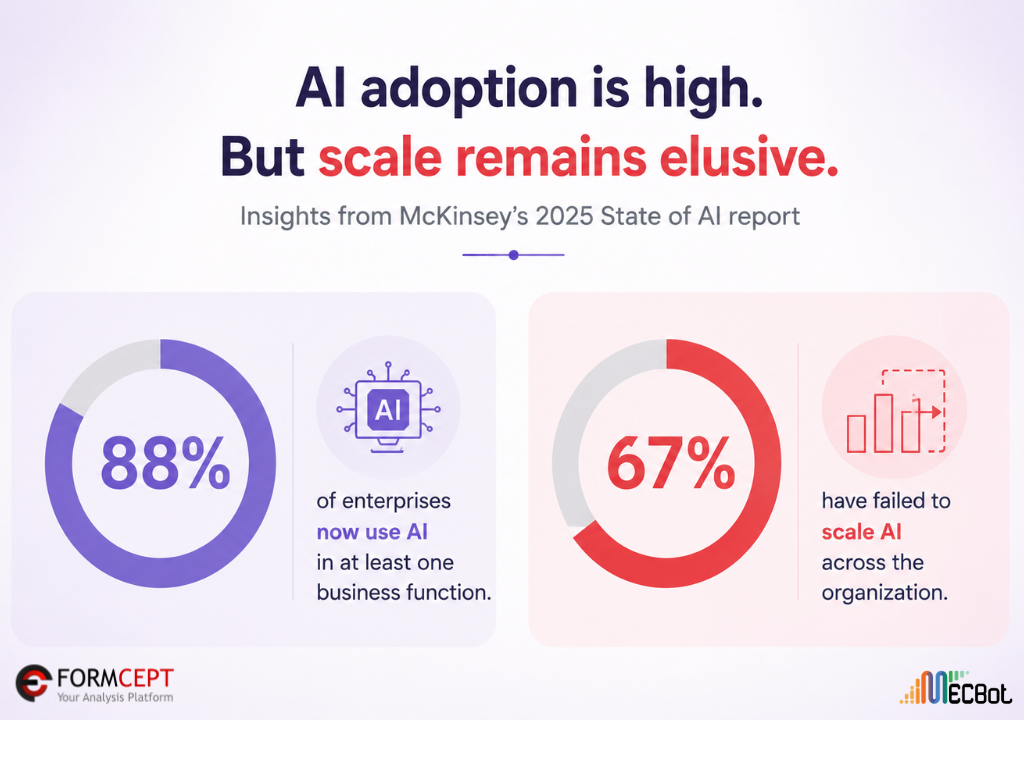
Controlled, small-scale pilot environments create artificial optimism. The reality check comes later, while scaling up.
Enterprise-wide deployment quickly introduces semantic drift, governance failures, and interoperability challenges due to rampant contextual inconsistency.
Scale amplifies deep-rooted contextual weaknesses.
A Contextual Foundation for Data Readiness at Scale
Defining the Next Decade of Enterprise AI With MecBot
Unified data does not automatically create a single, unified source of contextual truth. It needs to be backed by domain-driven ontologies, continuous governance, a real-time context engine, and a Gen-AI powerhouse built on top of it that transforms user intent into continuously evolving decision superintelligence, just in time.
FORMCEPT’s MecBot is designed precisely for this.
- Deep Context Engineering, Humanized
MecBot’s context engine, MecBrain, recognizes that critical enterprise knowledge extends well beyond structured databases. It lives and breathes inside emails, meetings, PDFs, Slack threads, ERP systems, industry reports, and undocumented operational habits. Enterprise intelligence, therefore, requires contextual convergence.
Furthermore, different kinds of enterprise context, like operational context, regulatory context, temporal context, behavioral context, and geographic context, continuously intersect with various organizational roles. Hence, executives, analysts, engineers, legal teams, and frontline operators all consume the same information differently.
Therefore, the success of enterprise reasoning with AI depends on preserving these relationships from the perspective of each role.
.png)
MecBot’s role-aware contextual superintelligence enables this in a no-code environment and with little or no manual supervision. MecBrain ensures that live, dynamic context is embedded right within the data, and not treated as an afterthought layered on top of models, while MecGPT, FORMCEPT’s Gen-AI innovation for contextual data interpretation, uses that context to understand and serve users’ intents and decision-making needs, just in time.
- Contextual Superintelligence, Always “On”
Business semantics evolve daily. Supplier risk profiles fluctuate. Compliance frameworks change. Customer intent expands. Organizational priorities shift.
Static embeddings cannot fully capture living enterprise dynamics.
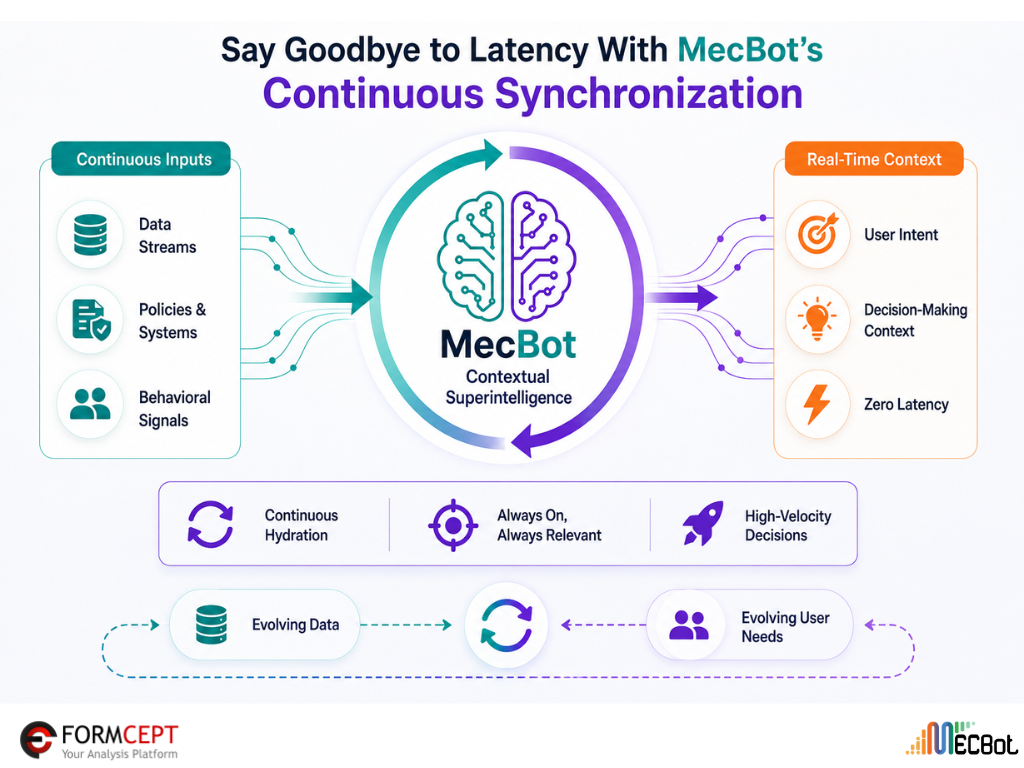
MecBot’s dedicated infrastructure, orchestration frameworks, retrieval layers, semantic alignment engines, and continuously updated knowledge graphs are capable of surfacing relevant signals precisely when operational decisions occur.
Stale context corrupts reasoning, and latency destroys decision velocity. No one understands this better than FORMCEPT’s data visionaries! MecBrain’s context-first architecture ensures continuous synchronization across evolving enterprise systems, data streams, policies, and behavioral signals.
- Integrated, Context-Aware Governance
The enterprise AI race is quietly shifting away from raw model power. Auditability, lineage tracking, access control, policy enforcement, spotless compliance, and flawless explainability determine whether AI systems remain deployable at enterprise scale.
Most GenAI-powered data platforms still govern only the surface layer, relying on hallucination checks and testing of sample outputs periodically while ignoring the deeper mechanics of missing context, context drift, and context degradation.
Beneath that thin governance veneer, regulatory mandates, statutory compliance, and enterprise policies continue to be enforced through fragmented manual workflows. The outcome is predictable: spiraling operational overhead, recurring governance blind spots, and a widening trust deficit across enterprise data ecosystems.
MecBot embeds governance directly into the core of the context architecture, enforcing dynamic guardrails that evolve alongside enterprise policies, regulatory mandates, and market shifts in near real time. Powered by banking-grade security, granular role-based access controls, deep awareness of industry regulations, and SOC 2 Type 2 compliance, MecBot orchestrates enterprise data pipelines with governance built into the flow, not bolted on afterward. Governance stops being a manual checkpoint and becomes a living layer of enterprise intelligence.
.png)
Conclusion
Gartner’s April 2026 survey identified poor data quality and persistent skill gaps as the leading causes of AI failure, both at 38%. At FORMCEPT, we recognize that these are system failures masquerading as human failures.
The truth, therefore, is inevitable: data readiness is above all a context problem–one that can make or break enterprises.
With MecBot’s contextual data interpretation, data readiness can become your superpower! No matter what your data challenges are, MecBot transcends them, transforming your data ecosystem into a decision-making superintelligence system that never lets you down. Learn more here: https://www.formcept.com/
.png)

.png)
.png)


